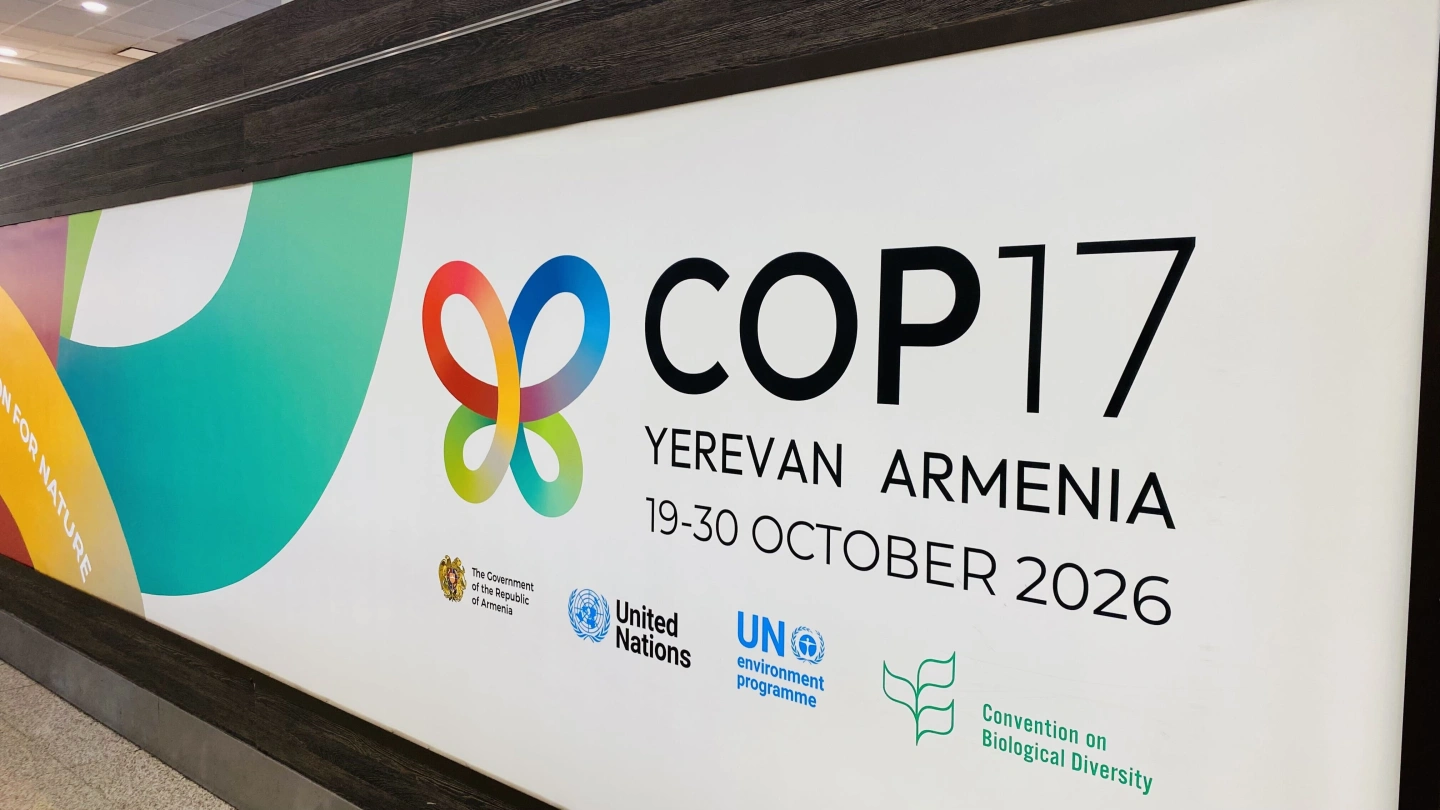

I just returned from the 2026 United Nations Biodiversity Conference (COP17) in Yerevan, Armenia, where the question of how to fund national nature plans loomed large. Across the preeminent nature summit this year, nearly 200 sessions explored ways to scale finance – especially from the private sector – for stopping and reversing nature and biodiversity loss around the world.
Despite the priority of the topic on the agenda, the official negotiation outcome fell notably short of developing pathways to meaningfully mobilize funds to meet key goals of the Kunming-Montreal Global Biodiversity Framework (KMGBF). The Yerevan Pathway, the roadmap designed to accelerate progress of the framework through 2030, includes just a few resolutions for many of the hardest questions facing governments on how to pay for protecting the natural environment – and the global economy which relies on keeping ecosystems in-tact.
But outside the negotiating rooms, the conversations were much more positive and solution oriented. Alongside the official talks, I had countless conversations with investors, companies, policymakers, and NGO partners on what is possible when the private and public sectors align their policies, actions, and incentives.
From my time on-the-ground, five major takeaways emerged:
The conversation has definitively shifted from philanthropic and moral imperative to business and financial ones. Nature loss is a material risk to company operations, supply chains, and investment portfolios, and addressing it strengthens long-term value and resilience. Ceres’ research shows that the primary contributors degrading critical ecosystem services have the potential to cost eight key sectors up to $430 billion per year, globally, representing a cumulative loss of $2.15 trillion over the next five years if left unchecked. This theme is especially prominent in conversations about food systems. However, key gaps remain in integrating resilience into decision-making by companies and investors.
Investors are stepping up on nature. Drawing on findings from a new policy brief – published by Ceres in partnership with other investor-facing organizations – we find growing evidence of investors stepping up to support the goals of the KMGBF. Over 680 institutional investors are building nature-related considerations into their strategies and investments and engaging with the companies in their portfolios, signaling their support for enabling policies.
Companies are already acting, often quietly and behind the scenes. At the same time, Nature Action 100, the largest global investor-led engagement initiative on nature and biodiversity, released a new benchmark assessment showing meaningful corporate progress across geographies and industries. The results highlight areas of meaningful progress, alongside critical gaps where companies must accelerate action.
Opportunities suited to private finance are still limited, but they are emerging. For investors, the challenge is matching projects with the revenue certainty, strong governance, and permanence they need. Sessions at COP17 explored those conditions for possible investment vehicles like habitat banks and biodiversity credit schemes, and how national biodiversity plans can be translated into investable project pipelines. Landscape-level solutions stand out as especially promising by bringing together companies, governments, local communities, and other stakeholders to carry out projects that can offer the scale, shared risk, multiple revenues, and long-term horizon suitable for institutional capital. By pooling funds and sharing resources, landscape initiatives also offer participating companies an advantageous path to manage complex environmental, economic, and social risks across an entire sourcing region.
Comparable, consistent data paves the way for aligning private financial flows. During COP17, the International Sustainability Standards Board, the global standard-setting organization that provides sustainability disclosure frameworks, published a draft Practice Statement on nature-related disclosures, drawing on voluntary reporting and disclosure frameworks such as the Taskforce on Nature-related Financial Discloses and Global Reporting Initiative. Although it is non-mandatory, the statement reflects a growing investor interest in better understanding nature-related risks and performance of their portfolio companies.
While the momentum we are seeing in the private sector is encouraging, my time in Armenia underscored the crucial work that Ceres is doing to bring more private sector actors to the table. Through our role as a partner of Nature Action 100 and beyond, Ceres is uniquely positioned to support key financial stakeholders in contributing to global efforts to accelerate solutions to safeguard the planet’s rich biodiversity and reduce the considerable risks facing businesses, communities, and economies around the world.